The vw id buzz 2026 cargo space family road trip range question is really four questions wearing one long search query: can it carry a family, how much luggage fits, how far can it travel, and how irritating will charging become? The short answer is promising, but the useful answer depends on trim, wheel size, weather, speed, and whether the third row is occupied.
The US-market ID. Buzz is a large electric van built on Volkswagen's MEB platform. Its appeal is not subtle acceleration or a giant touchscreen. It is the square body, sliding doors, upright seating, and ability to turn a family vehicle into a rolling logistics experiment. That makes measurable details more important than launch-event adjectives.
The range baseline for a 2026 family trip
The 2026 model year should be evaluated against the available US ID. Buzz specification rather than an optimistic early brochure. The long-wheelbase version uses a battery with roughly 91 kWh of usable energy, and rear-wheel-drive versions have been rated around 230 miles of EPA range, depending on configuration. All-wheel drive is in a similar neighborhood but can give up a small amount of efficiency because it adds hardware and weight.
That figure is a planning baseline, not a promise that the van will travel 230 miles on every interstate run. A loaded vehicle traveling 75 mph, running climate control, and climbing through strong wind can consume energy quickly. Cold temperatures also reduce usable range and can slow charging until the battery reaches its preferred temperature. For a family trip, I would plan the first charging stop well before the dashboard reaches single digits. Arriving with 15 to 20 percent remaining creates options when a station is occupied, offline, or protected by the ancient ritual of a broken payment terminal.
A realistic highway plan often means treating approximately 170 to 200 miles as a comfortable leg in mild conditions, with less available in winter or at high speed. That is not a laboratory result; it is a planning posture. The vw id buzz 2026 cargo space family road trip range decision becomes easier when the itinerary includes reliable fast chargers every 100 to 150 miles rather than assuming the maximum EPA number is a daily operating target.
The vehicle supports DC fast charging at a useful rate, with ideal sessions from about 10 to 80 percent taking roughly half an hour or somewhat longer depending on temperature and charger output. Families should budget extra time for bathroom breaks, food, and a second attempt when the first stall refuses to authenticate. Charging speed is only as useful as the network at the destination and along the route.

Cargo space with two or three rows in use
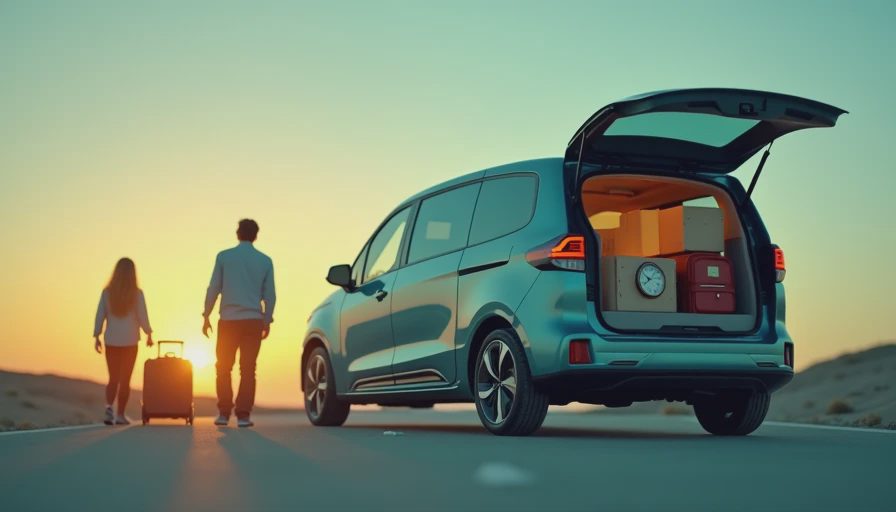
The vw id buzz 2026 cargo space family road trip range package is strongest when the van is treated as a configurable room rather than a conventional SUV. With all three rows occupied, cargo space behind the third row is limited but still useful for soft bags, backpacks, a compact stroller, or groceries. Hard-shell suitcases will consume that area quickly, especially if every passenger brings a personal item.
Fold the third row and the vehicle becomes substantially more practical. Published US figures for the current long-wheelbase layout are commonly described as roughly 75 cubic feet behind the second row and more than 140 cubic feet with rear seating folded, depending on the measurement method and seat configuration. Those numbers are not directly comparable with every minivan or crossover because manufacturers measure cargo volume differently. Still, the shape is favorable: a tall box is easier to load than a sloping rear hatch.
Before buying, perform a physical luggage test. Put one large suitcase, one carry-on, a cooler, a folded stroller, and a charging cable bag behind the seats you expect to use. Then measure whether the hatch closes without compressing the stroller. A spreadsheet can tell you the theoretical volume; it cannot tell you whether a cooler blocks the rear-view mirror or whether a third-row passenger has somewhere to place a water bottle.
The sliding doors are a genuine family advantage. They reduce the chance of striking a neighboring vehicle in a crowded parking lot and make loading a child seat less awkward. The tall roof also helps adults reach the center of the cabin. However, a large body still needs parking discipline, and the turning circle and overall length deserve a test drive before committing to a tight garage.
Seating, comfort, and software friction
Depending on trim, the US ID. Buzz can seat six or seven people. The exact second-row layout matters more than the headline seat count. Captain's chairs improve access to the third row but remove a convenient center position. A bench can carry more people but makes the path to the rear less elegant. Families should check shoulder room, car-seat attachment points, and whether a rear-facing seat interferes with front-seat travel.
The cabin's quietness is an asset on long trips. Electric propulsion removes engine vibration and makes conversation easier at steady speed. That quiet can also expose tire noise, climate-control fan noise, and software delays. Volkswagen's infotainment systems have improved across recent updates, but an owner who treats the interface as a critical cockpit component should test navigation search, wireless phone projection, route charging logic, and voice controls before purchase. A screen that needs several taps to find a charger is not a minor annoyance at 10 percent battery.
The vw id buzz 2026 cargo space family road trip range review should therefore include a software log, not just a seat measurement. Record the software version, navigation behavior, charging-plan accuracy, and whether the system remembers driver preferences after a power cycle. OTA update promises are useful only when the update arrives, installs cleanly, and fixes the reported behavior instead of moving the button.
A workable road-trip test procedure
Start with a route that includes interstate driving, a short urban section, and one fast-charging stop. Load the van exactly as a family would: passengers or equivalent ballast, luggage, snacks, and a full climate-control schedule. Begin at 100 percent, record ambient temperature and tire pressures, and note the predicted range. At every stop, record miles traveled, battery percentage, average consumption, and charging time.
Repeat the same route in a different temperature if possible. A single pleasant-weather drive can hide winter limitations. Compare predicted remaining range with actual battery use rather than celebrating a large estimated number. Engineers will recognize the principle: the useful result is repeatable data with controlled variables, not one heroic screenshot.
Also test the public-charging workflow. Check whether the vehicle preconditions the battery when a charger is selected in its navigation system, whether a preferred charging limit can be saved, and whether the phone app reports charging status promptly. An Electrify America, EVgo, or Tesla-compatible stop can produce different experiences based on hardware, membership, and site congestion, so route redundancy matters.
Is the ID. Buzz a good family road-trip buy?
The strongest case for the vehicle is a family that values interior access, flexible cargo volume, a distinctive cabin, and home charging. Overnight charging can cover normal daily driving, while a carefully planned road trip reduces the burden of public stops. The weak case is a driver who regularly travels long distances at high speed, lives in severe winter conditions, or expects SUV-like efficiency from a tall, heavy van.
The vw id buzz 2026 cargo space family road trip range calculation favors realistic expectations. Think of it as a comfortable electric people mover with a roughly 200-mile planning radius between dependable fast chargers, not as a gasoline minivan with a five-minute refill. Confirm the final EPA label, battery specification, seat layout, charging compatibility, and cargo measurements for the exact 2026 trim.
My buying checklist is simple: drive the loaded vehicle, test every seat, measure the luggage, verify the home charger installation, and simulate the longest regular route in the navigation system. Then price insurance, tires, charging, and any dealer-installed accessories. The ID. Buzz makes a compelling family machine when its constraints are documented before the first vacation, rather than discovered beside a full charger queue with three bored passengers in the back.

No letters yet — be the first guest to write.