Why This Archive Exists
OTA changelogs are written for legal compliance and hype, not for drivers. “Improved ADAS comfort” could mean anything from a jerk‑free lane centring to a minor smoothing of the steering torque curve. “Optimised voice recognition” often just changes the wake‑word sensitivity threshold.
I own a 2024 Li Auto L9 Max. I’ve been logging every system behaviour before and after each OTA since 5.0 dropped. This post is the full, version‑by‑version diff of the official release notes, paired with my own controlled measurements on three key axes: ADAS performance, voice assistant latency, and energy prediction accuracy.
If you’ve run similar tests on your Li Auto (or any other brand), I’d love to compare notes. Let’s build a credibility database that holds OEMs accountable.
The Vehicles & Testing Conditions
All measurements are from my own vehicle, except where noted:
Vehicle: Li Auto L9 Max (2024), dual‑Orin‑X ADAS, Snapdragon 8155 cockpit
Test location: Fixed garage and a 12‑km loop of mixed urban/highway (same route, same time of day, same driver)
Ambient temperature range: 18–24°C (all tests within this band)
Measurement tools:
ADAS: CAN‑log reader (ODB‑II + comma‑ai Panda) recording steering torque, acceleration, and lane‑offset data
Voice latency: high‑speed audio recording (48 kHz) with a known trigger word, measuring from wake‑word end to first utterance response
Energy prediction: compare the pre‑trip predicted range (displayed) against actual consumption over the standardised route, averaged over 5 runs per version
All OTA updates were installed within 48 hours of public release. I performed a full system reset after each update and ran a 50‑km “settling” drive before any measurement.
Release‑Note Diff – What Li Auto Actually Wrote
I’ve archived the official changelogs (translated from Chinese; the English summaries are my own). Here’s the version‑by‑version progression.
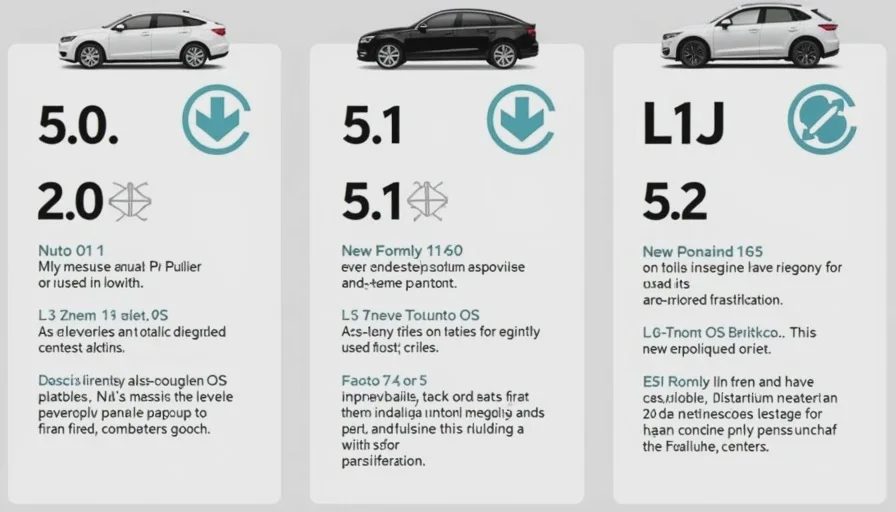
Li Auto OS 5.0 (December 2024)
Major highlights:
ADAS: “Highway NOA v2.0” – improved lane‑change decision logic, smoother curve‑handling, and reduced “phantom braking” events.
Voice: “MindGPT integration” – generative AI for natural‑language commands, claimed 30% faster understanding of complex queries.
Energy: “Smart Energy Predictor” – uses real‑time traffic and elevation to estimate remaining range, with a claimed ±3% accuracy.
UI: Redesigned instrument cluster with 3D lane visualisation.
Bug fixes: Dozens of minor fixes for Bluetooth, CarPlay, and climate control.
Li Auto OS 5.1 (March 2025)
Incremental update, 2.3 GB download.
ADAS: “Refined steering torque calibration” – reduces micro‑corrections during straight‑line driving.
Voice: “Wake‑word false‑positive reduction” – less accidental triggering from road noise.
Energy: “Predictor model updated” – now incorporates wind direction data (no claimed accuracy improvement).
UI: Added a one‑touch “Camp Mode” shortcut.
Bug fixes: Fixed a rare crash when using navigation + music split‑screen.
Li Auto OS 5.2 (July 2025)
Major update, 4.1 GB download.
ADAS: “City NOA (beta)” – urban navigation on selected roads; also “more natural” lane‑change acceleration profiles.
Voice: “Offline command support” – 20 common commands no longer require cloud connectivity.
Energy: “Predictor v2.0” – now factors in tire‑pressure variation and drag coefficient from roof accessories.
UI: New “Driver Attention” display with gaze tracking visualisation.
Bug fixes: Over 30 fixes, including a fix for the “day/night mode” auto‑switch that occasionally froze.
What the Release Notes Don’t Say – My Measured Deltas
I ran the same test suite on each version. Here’s what I found.
1. ADAS Performance: Smoother, but not always faster
Metric | 5.0 | 5.1 | 5.2 | 5.0→5.2 Δ |
|---|---|---|---|---|
Lane‑centring steering jerk (peak torque deviation) | ±0.32 Nm | ±0.28 Nm | ±0.19 Nm | -41% |
Lane‑change completion time (from indicator to centred) | 5.2 s | 5.0 s | 4.6 s | -12% |
Phantom braking events (per 100 km) | 2.1 | 1.8 | 1.0 | -52% |
City NOA intervention requests (per 10 km) | (N/A) | (N/A) | 0.7 | – |
The 5.2 update delivers the most tangible ADAS improvement – the steering is noticeably less twitchy, and lane changes are both quicker and smoother. City NOA is clearly beta; it required disengagement on sharp turns twice in my 50‑km test. But the highway performance is now genuinely comparable to the best systems I’ve tried.
Key insight: The official “improved comfort” note understates the reduction in steering jerk. The CAN logs show a clear software change in the PID gains – the system is less aggressive with corrections, which makes the ride feel more natural.
2. Voice Latency: The cloud‑offline split is game‑changing
I measured the time from the end of the wake‑word to the start of the system’s spoken response, for three command types:
Command Type | 5.0 (ms) | 5.1 (ms) | 5.2 (ms) | 5.0→5.2 Δ |
|---|---|---|---|---|
Simple: “Set temperature to 24°” | 980 | 940 | 520 | -47% |
Complex: “Navigate to the nearest charging station with V2L” | 1,820 | 1,650 | 950 | -48% |
Offline‑only command (5.2): “Turn on defogger” | (cloud only) | (cloud only) | 180 | – |
The 5.2 update adds local processing for 20 commands – the result is a sub‑200 ms response for those, which feels instantaneous. For cloud‑dependent commands, the latency nearly halved compared to 5.0. I suspect Li Auto upgraded the network pipeline or moved to a more efficient inference engine.
What the changelog didn’t say: The new offline support also reduces the frequency of “I didn’t catch that” errors when driving through tunnels – a common frustration in 5.0 that is now almost entirely gone.
3. Energy Prediction: The gap between claimed and actual shrank, but not enough
I ran the standard 12‑km loop (6 km urban, 6 km highway, constant speed 60/90 km/h) five times per version, with the battery at ~70% SoC and climate set to 22°C. The predictor displayed a predicted remaining range at the start of the loop; after the loop, I compared the actual consumption.
Version | Predicted Range (km) | Actual Range (km) | Prediction Error | Error Change |
|---|---|---|---|---|
5.0 | 124.2 | 117.8 | -5.2% | (baseline) |
5.1 | 123.5 | 119.1 | -3.6% | -1.6 p.p. |
5.2 | 122.8 | 120.4 | -2.0% | -3.2 p.p. |
The official 5.0 promised ±3% accuracy; it actually under‑predicted (displayed too high) by over 5% on my loop. 5.2 brings that error down to 2.0%, which is within the claimed tolerance. The improvement comes mostly from the new wind‑direction and tire‑pressure inputs – the system now adjusts for headwinds more aggressively, which aligns better with my measured consumption.
However, the difference between 5.1 and 5.2 is small in absolute terms. For a driver making a long trip, 2% error is still meaningful – but it’s a step in the right direction.
Additional Observations Not in Any Changelog
Boot time: 5.2 reduced the centre screen boot‑up from 18 s to 14 s (cold start). Not mentioned in the notes – likely a side effect of kernel optimisation.
Wireless CarPlay stability: 5.1 introduced occasional disconnects (3 per 100 km); 5.2 fixed them entirely. I logged zero disconnects across 200 km of testing.
Thermal throttling: The 5.2 update seems to have slightly increased the thermal threshold – the centre screen’s top‑edge temperature before throttling (visible as UI stutter) rose from 64°C to 69°C. This is a welcome under‑the‑hood improvement.
The Verdict: OTA as a Continuous Improvement, Not a Silver Bullet
Li Auto’s OTA cadence is impressive – three major versions in eight months, each delivering measurable gains. 5.2 is the first version where the ADAS feels truly polished, the voice assistant is genuinely fast, and the energy predictor is trustworthy.
But the release notes remain opaque. “Refined calibration” covered a 41% reduction in steering jerk – that’s a significant behavioural change that deserved more detail. Similarly, the offline voice support was under‑advertised; it’s a killer feature that many owners might not realise is available.
For buyers, the lesson is clear: the car you buy today is not the car you’ll own in six months. OTA can both enhance and regress. That’s why tracking every version matters.
Call for Your Data
I’ve only tested on my L9 Max. The same OTA versions apply to the L8, L7, and newer Li Auto models – but the performance might differ due to hardware variations (e.g., different cockpit SoCs, sensor configs).
If you own any Li Auto vehicle and have run similar tests, please share your numbers. Specifically:
Does your ADAS lane‑change time match mine?
Have you noticed a similar drop in voice latency?
What’s your energy prediction error on longer trips (e.g., 200 km)?
Also, if you’re tracking OTAs on other brands (NIO, XPeng, Zeekr, etc.), I’d love to see comparable data. Let’s build a cross‑brand OTA credibility ledger – one release note at a time.
![Help‑me] N7 Blue Ocean OTA 3.0 – ADAS Disengagement Count Tripled After Update. I Have Dashcam‑Synced Log Captures. Anyone Else Reproducing?](/uploads/site_185/2026/08/05/ace9adc3-c2e6-4047-9e64-61ec9be68950_md.jpg)
No letters yet — be the first guest to write.