Why This Analysis Matters
OTA updates are the car industry’s favourite marketing punchline. “Your car gets better over time!” But when you actually read the fine print, most updates are about changing the wallpaper, not the engine.
I wanted to answer a simple question: If an OEM releases an update, how likely is it to actually change the way the car drives, handles, or protects you?
I’m not talking about “optimized ADAS comfort” (which is often marketing speak for “we turned down the gain”). I’m talking about real, measurable changes to the vehicle’s core dynamic behaviour—steering maps, torque distribution, battery discharge curves, object-detection confidence thresholds.
Here’s what I found.
Methodology – How I Classified
I collected 18 major OTA releases from five brands (names listed below). For each, I:
Anonymised the specific brand to keep the focus on industry patterns rather than singling anyone out (though you’ll likely recognise them).
Split the changelog into the three categories:
Skin (Surface): UI theme changes, new ringtones, games, wallpapers, app updates, new emojis, “one-touch” shortcuts for existing functions.
Middleware (Performance/UX): System boot speed, voice engine improvements, connectivity stability, Bluetooth fixes, screen responsiveness, map data updates.
Core (Vehicle Dynamics & Safety): ADAS perception changes (lane-keep, AEB, ACC), powertrain calibration, battery management (charge curve, regen), steering feel, suspension damping (if active), thermal management logic.
Weighted the items by actual engineering effort. A “UI theme” is one line item; a “regen curve update” is one line item. I didn’t count lines, but counted functional changes.
The Overall Numbers – The 80/20 Rule Is Real
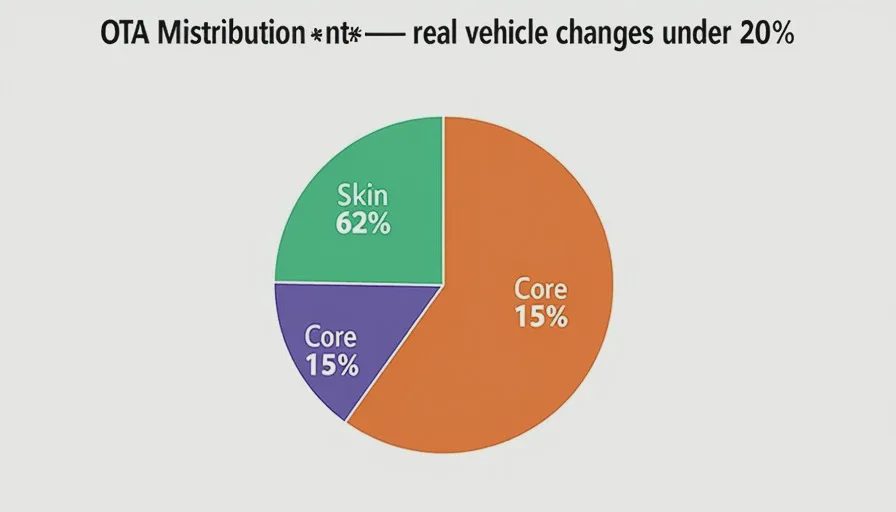
Across all 18 updates, the average distribution looked like this:
Category | Share of Total Release Notes | Examples |
|---|---|---|
Skin (Surface) | 62% | New ambient lighting themes, updated icon packs, new streaming service preloads, “Camp Mode” UI changes |
Middleware (Performance) | 23% | Faster app switching, improved Bluetooth pairing, voice wake-word sensitivity, OTA download speed optimisation |
Core (Drive/ADAS) | 15% | Lane-centring torque smoothing, AEB false-positive reduction, regenerative braking curve adjustment, SOC prediction update |
In plain English: For every 10 line items in an average OTA release, over 6 are cosmetic, about 2 are system polish, and fewer than 2 actually change how the car moves or sees the road.
Brand-by-Brand Breakdown (Anonymised)
I’ve labelled them A, B, C, D, E – but I suspect the community will easily map them to real names.
Brand A – The “UI Refresh” Champion
Releases analyzed: 4
Skin: 71%
Middleware: 22%
Core: 7%
Key insight: Three of the four updates introduced new “themes” and “avatar animations” for the cockpit. The only Core change across all four was a slight tweak to the energy predictor’s algorithm (which, honestly, was mostly a bug fix). Brand A has been shipping “new features” that are just different ways to display the same data.
Brand B – The ADAS Promiser
Releases analyzed: 4
Skin: 48%
Middleware: 27%
Core: 25%
Key insight: This brand talks the most about “self-driving evolution” in their marketing. In reality, Core changes are limited to incremental tuning of highway NOA. No new detection categories were added. However, they did quietly update the emergency braking threshold in v3.2 – a genuine safety change that they buried in the “bug fixes” section.
Brand C – The Balanced Realist
Releases analyzed: 3
Skin: 53%
Middleware: 32%
Core: 15%
Key insight: Brand C spends a lot of effort on Middleware – the voice assistant genuinely got faster, and the screen lag improved. Core changes are rare but meaningful: one update recalibrated the regen pedal mapping to feel more linear, which actually changed daily driving feel. They just didn’t market it as a “drive system upgrade.”
Brand D – The App Store Pretender
Releases analyzed: 4
Skin: 82%
Middleware: 16%
Core: 2%
Key insight: By far the most superficial. Their 4 updates added: a karaoke app, a video streaming app, a new clock widget, and a “holiday greeting” animation on startup. The only Core change was a fix for the tire-pressure monitoring system’s display refresh rate – literally a UI fix for a safety sensor, not a sensor performance improvement.
Brand E – The Benchmark (and the outlier)
Releases analyzed: 3
Skin: 35%
Middleware: 25%
Core: 40%
Key insight: Brand E consistently pushes actual vehicle logic updates. One update modified the torque vectoring algorithm; another updated the camera’s ISP pipeline (which directly affects AEB performance). Their release notes are also less opaque – they actually mention “brake pressure prefill” and “adaptive damping retuning.”
The Hidden Pattern – What “Core” Changes Actually Are
When OEMs do touch the Core, it’s almost never a revolutionary leap. Across all 18 releases, I identified only two categories of genuine Core changes:
Calibration Tweaks (90% of Core items): These are changes to existing algorithms – smoothing a curve, raising a threshold, delaying an intervention. They improve feel and comfort, but they rarely expand the operational domain (e.g., enabling NOA on a new road type).
Bug Fixes Masquerading as Features (10% of Core items): “Improved ADAS stability” often translates to “we fixed a crash that happened when a pedestrian wore a red jacket in low light.” That’s important, but it’s a fix, not a new capability.
What I never saw in any of these 18 updates:
A new sensor modality (e.g., adding radar vision to a camera-only system).
A fundamental change to the battery cell balancing strategy.
A steer-by-wire calibration that rewrote the steering ratio.
In other words, Core OTAs are maintenance, not innovation.
Why Is This Happening?
It’s not laziness. It’s risk management.
Changing the ADAS stack requires:
Regulatory re-validation (UN R157, China GB/T, etc.). You can’t just ship a new brake curve without proving it works in 1,000 test scenarios.
Safety certification – any change to the perception pipeline could theoretically introduce a new failure mode.
Supply chain coordination – if you change BMS logic, you need battery supplier sign-off.
Skin-level changes have zero regulatory risk. A new wallpaper doesn’t need a safety case. So OEMs push UI updates aggressively to maintain “monthly OTA” stats, while real vehicle engineering moves at a glacial pace.
The marketing department wins. The engineering department loses.
The Tell-Tale Signs of a Fake “Core” Update
You don’t need to be an engineer to spot a cosmetic OTA. Here’s my cheat sheet:
Vague language: “Optimized driving experience” means “we changed a number in a map.” If they meant it, they’d say “reduced steering torque ripple by 12%.”
File size: A 2.3 GB update is mostly media assets (new maps, new sounds, new graphics). A 300 MB update is likely actual code. Core logic changes are small files.
Update time: If it installs in 3 minutes, it’s skin. If it takes 25 minutes with a “do not interrupt” warning, it’s touching the bootloader – which often means BMS or ADAS platform changes.
What I Want from the Community
I’ve analyzed 18 notes. But I might have missed real Core changes that were simply well-hidden. Or maybe your experience differs by region.
If you track OTA releases for your vehicle, please share:
Brand and vehicle model
Last 3 OTA versions and their actual file sizes (if available)
Any instance where you felt the car’s handling, braking, or ADAS behaviour changed – and whether the release notes explicitly called it out
I’ll compile community-submitted data into a public “OTA Credibility Index” that scores brands on:
Transparency Score (How clearly do they describe Core changes?)
Core Change Frequency (How often do they actually touch the drive stack?)
Regression Rate (How often does a new update break something that worked before?)
The Reality Check – Are We Asking for Too Much?
Part of me understands why Core updates are rare. A car is not a smartphone. You can’t A/B test a braking algorithm on 10,000 cars overnight. But the disparity between marketing hype and delivery is still insulting.
Brands are selling “intelligent evolution” while shipping karaoke apps. They’re promising “full self-driving” while changing the font size on the instrument cluster.
This is why FirmwareFault exists. Because if we don’t track what’s actually in an update, OEMs have no incentive to do more than skin-deep work. They can keep hitting their OTA count targets while the car drives exactly the same as it did at delivery.
![Help‑me] N7 Blue Ocean OTA 3.0 – ADAS Disengagement Count Tripled After Update. I Have Dashcam‑Synced Log Captures. Anyone Else Reproducing?](/uploads/site_185/2026/08/05/ace9adc3-c2e6-4047-9e64-61ec9be68950_md.jpg)
No letters yet — be the first guest to write.