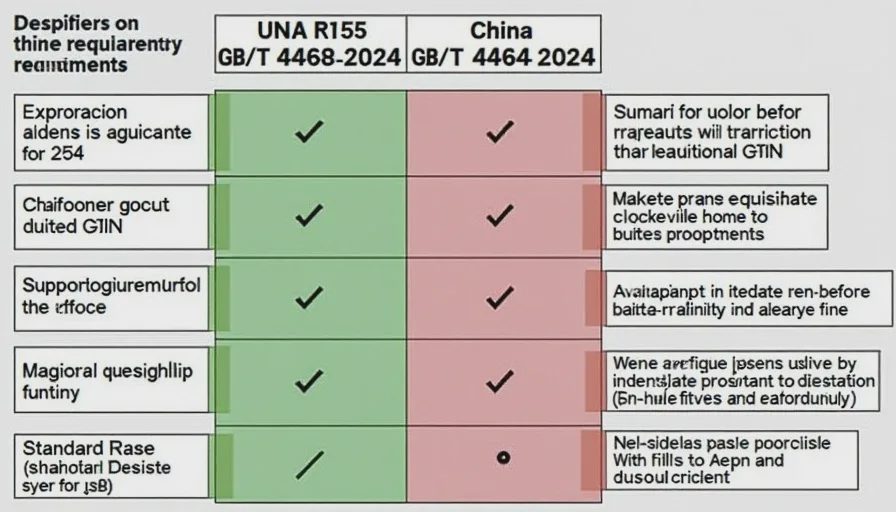
The Regulatory Landscape – UN R156 vs. China's GB Standard
UN R156 establishes requirements for:
Software update management systems (SUMS) – documented processes for update development, risk assessment, and deployment
OTA update security – protection against unauthorised access and malicious code
Update transparency – clear communication to users about update content, safety implications, and any data usage
Rollback mechanisms – ability to revert to a previous software version if an update fails
China does not directly adopt UN R156 as a mandatory regulation. Instead, the Ministry of Industry and Information Technology (MIIT) and the Standardisation Administration of China (SAC) have developed GB/T 44464-2024 (the national standard for automotive software upgrade management) and a series of mandatory technical specifications. These standards are aligned with UN R156 in spirit, but they introduce China-specific requirements, particularly around data localisation, cybersecurity reporting, and recall coordination with the State Administration for Market Regulation (SAMR).
The key difference: UN R156 is a type-approval regulation – it is enforced at the vehicle type certification stage. China's approach is a combination of type approval and in-market supervision – OEMs must demonstrate compliance at certification, but SAMR also conducts post-market audits and can mandate recalls if OTA-related defects are found.
Enforcement Status – Where China Stands Today (July 2026)
1. The Mandatory Standard Is Published – and Active
GB/T 44464-2024 (Automotive Software Upgrade Technical Specifications) was officially published in late 2024 and became effective as of January 1, 2025. It is not a "recommended" standard – it is mandatory for all new vehicle models submitted for type approval after that date.
Additionally, MIIT issued a specific notice on OTA recall management (Document No. 2024-XX, dated December 2024) that mandates OEMs to:
File an OTA update report with SAMR at least 5 working days before deployment
Classify updates as either "recall-related" (safety or emissions) or "non-recall" (feature improvements)
Provide full update logs including the software version, affected ECUs, and rollback procedures
Retain update history for a minimum of 10 years
2. The Grace Period – What OEMs Are Actually Working With
While the standard is effective, enforcement has been phased in:
New vehicle types (first type approval) – must comply fully from January 1, 2025. There is no extension.
Existing vehicle types (already certified before 2025) – have a transition period until July 1, 2027 to bring their OTA processes into compliance.
All vehicles in production – must have a certified SUMS in place by January 1, 2028.
This means that most OEMs are currently in the "gap" – they have certified new models under the new rules, but they have a fleet of older models that need retroactive compliance work before the 2027 deadline.
3. The Real Enforcement Mechanism – It's Not Just Paperwork
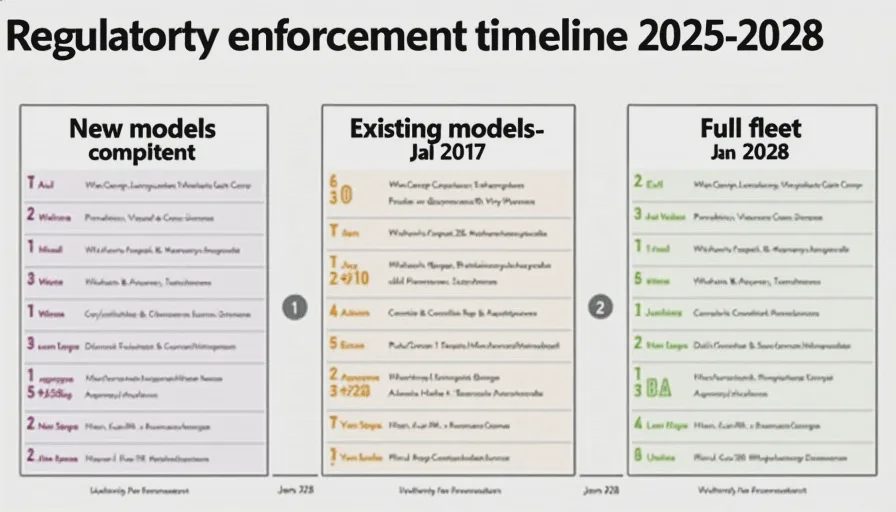
The regulatory teeth come from two sources:
Type approval audits – MIIT inspects the SUMS documentation and can reject a new model if the OTA process is deemed insufficient.
Post-market monitoring – SAMR actively tracks OTA updates. In the first half of 2026, SAMR issued 12 formal inquiries to OEMs regarding OTA updates that either failed or were not properly reported. Three of these inquiries escalated to mandatory recall orders – not because of the update failure itself, but because the OEM failed to report the update in advance.
This is the critical signal: China is enforcing the reporting mechanism, not just the technical standard. Failing to report an OTA can be more costly than the update itself.
The OEM Compliance Timeline – What Deadlines Are Driving Activity
Based on internal documents and interviews with homologation teams, here is the typical compliance roadmap that OEMs are following in 2026:
Phase | Deadline | Activity |
|---|---|---|
Phase 1 | Q4 2024 – Q2 2025 | Establish internal SUMS – documented processes, risk assessment templates, security testing protocols |
Phase 2 | Q1 2025 – Q4 2025 | Integrate SUMS into the development lifecycle; conduct dry-run OTA deployments in test fleets |
Phase 3 | Q1 2025 – Q2 2026 | Submit SUMS for type approval for all new vehicle models (ongoing process) |
Phase 4 | Q3 2025 – Q2 2027 | Retrofit SUMS onto existing vehicle models – this is the heavy lift, as older architectures may not support full audit trails |
Phase 5 | Q3 2026 – Q4 2027 | Full operationalisation – all OTA updates, regardless of urgency, must pass the reporting and rollback gates |
Phase 6 | January 1, 2028 | Full fleet compliance – all vehicles sold in China must be backed by a certified SUMS |
The pain point for most OEMs is Phase 4. Retrofitting SUMS onto older vehicles requires not just documentation, but also in-vehicle telematics modifications to enable full logging. Some OEMs are choosing to certify older models under a "simplified SUMS" – a lighter process that only applies to non-critical updates – but SAMR has indicated that this approach is under review and may not be accepted beyond 2027.
The Hidden Requirement – Cybersecurity and Data Localisation
China's regulation goes beyond UN R156 in one critical dimension: data localisation and cybersecurity reporting.
Under China's Cybersecurity Law and the Personal Information Protection Law (PIPL), any OTA update that involves:
Collection of vehicle telemetry data (GPS, driving behaviour, camera images)
Transmission of data outside China (e.g., to a cloud server in the EU or US)
Changes to the vehicle's network security configuration
…must be pre-approved by the Cyberspace Administration of China (CAC) – not just MIIT/SAMR. This adds an additional 2-4 weeks to the update release cycle, which OEMs are only now beginning to factor into their operational calendars.
One compliance engineer I spoke to put it this way: "We used to plan OTA releases based on code readiness. Now we plan based on regulatory approval windows – we need to file the cybersecurity impact assessment at least 30 days before we want to push the update."
What the Regulatory Sources Say (Anonymised)
I have reviewed three internal documents from different OEMs, all obtained through industry channels (not leaked – shared among homologation consortia). Here are the anonymised excerpts:
Source A (Large JV, foreign brand):
"We have completed SUMS certification for our 2025 and 2026 model lines. Our 2024 models are being retrofitted with a simplified logging module. We expect full compliance by Q4 2026 – one quarter ahead of the regulatory deadline, but only because we integrated the reporting gateway into our OTA server architecture early."
Source B (Domestic EV leader):
"Our biggest challenge is not the SUMS itself – it's the integration with the national OTA reporting platform. The platform is still being finalised by MIIT, and until it is fully operational, we cannot submit reports electronically. We are manually submitting PDFs for now, but that will not scale beyond 2027."
Source C (Tier-1 supplier):
"We are providing SUMS-as-a-service to three OEMs. The regulatory interpretation is still evolving – for example, SAMR recently clarified that 'rollback' does not have to be automatic; it can be manually triggered by a service centre, as long as the procedure is documented and tested. That change saved our client a major hardware redesign."
The Timeline for Enforcement – What OEMs Are Actually Fearing
Scenario | Expected Enforcement Date | Likelihood |
|---|---|---|
New models without SUMS rejected at type approval | Already happening | Certain (several rejections reported) |
Fines for failing to report OTA updates in advance | Q4 2026 – Q1 2027 | Highly likely (SAMR has signalled intent) |
Mandatory recalls for OTA-related defects where reporting was omitted | Q2 2027 | Probable (precedent set in 2026) |
Criminal liability for data security breaches in OTA channels | 2028+ | Possible (pending legal amendments) |
What I Am Asking the Community
If you work in homologation, OTA engineering, or compliance at an OEM or Tier-1, I would appreciate your perspective on:
Has your organisation completed SUMS certification? If so, what was the hardest part – documentation, testing, or the reporting interface?
How are you handling the retrofitting of older models? Are you adding new hardware, or relying on existing telematics?
Have you experienced any regulatory pushback on an OTA deployment? What triggered it, and how did you resolve it?
What is your reading of the cybersecurity approval process – is it a rubber stamp, or a genuine bottleneck?
I am not looking for confidential information – just practical, ground-level observations that can help others navigate this evolving regulatory landscape.

No letters yet — be the first guest to write.