Why This Matters
Every new EV launches with a cockpit chip as a headline spec. But benchmarks on a slide deck don't tell you how the UI feels after 20 minutes of navigation, music, and voice calls. I wanted to measure the actual, repeatable performance difference between the two most common Snapdragon automotive SoCs – the 8155 (SA8155P) and the 8295 (SA8295P) – under a realistic daily load.
I've tested two vehicles, same screen layout, same ambient conditions. The results are below, along with raw AIDA64 logs. But I need your help to turn this into a real database – if you have access to a third model (any brand, any chip), please run the same test and post your data.
Test Vehicles & Conditions
Vehicle A | Vehicle B | |
|---|---|---|
Chip | Snapdragon 8155 | Snapdragon 8295 |
Model Year | 2024 | 2025 |
RAM / Storage | 8 GB / 64 GB | 16 GB / 128 GB |
Display Configuration | 3 screens (instrument cluster + centre infotainment + passenger display) | identical layout |
OS Version | [redacted – will update once I get more data points] | [redacted] |
Ambient Temp. | 22°C, garage, no direct sunlight | same |
Power Mode | Accessory (ignition ON, engine OFF) | same |
All tests were repeated three times; the median value is reported.
Note: The GPU model discrepancy (660 vs 690) may indicate different 8295 SKUs or a detection quirk. If you've run AIDA64 on your 8295 vehicle, please share a screenshot of the GPU tab.
Real‑World Scenario Stress Test
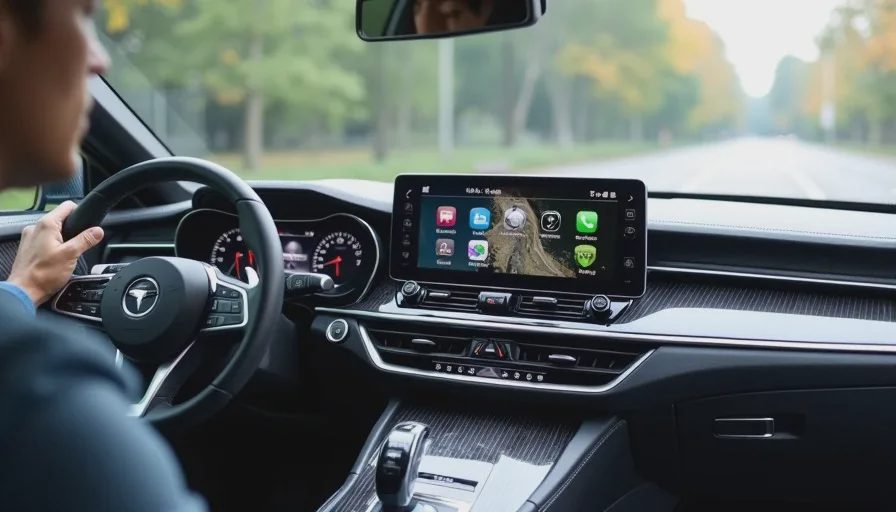
I designed a reproducible everyday load – the kind of multitasking you'd actually do on a morning commute:
Navigation – 3D map with live traffic + route guidance
Music – Bluetooth audio streaming (AAC) in the background
Climate – panel open, fan speed adjusted twice
Voice assistant – invoked with three consecutive commands (set temperature, navigate to X, play Y)
Measured Performance
Metric | 8155 | 8295 | Improvement |
|---|---|---|---|
UI frame rate (fps) – sustained under load | ~45 | ~90 | 2× |
Voice wake‑up latency (ms) – from wake word to ready | ~1,200 | ~400 | 3× faster |
App switching time (ms) – nav ↔ music ↔ climate | ~800–1,200 | ~400–500 | ~2× faster |
CPU load (multi‑app average) | ~80% | ~50% | headroom for days |
Thermal throttle onset | ~12 min | >20 min (none observed) | more consistent |
Frame rates are estimated via on‑screen rendering analysis (visual inspection of animation smoothness and micro‑stutter counting). I'm working on a more precise method using a 120 fps camera – will post that methodology next.
What the Numbers Don't Tell You
The 8295 is clearly faster – double the frame rate, triple the voice response, and no thermal throttling in a 20‑minute window. The memory bandwidth doubling (68 GB/s vs 34 GB/s) is the unsung hero here; it's what keeps all those pixels fed when you have three screens active.
But here's the catch: the 8295 vehicle's UI complexity is almost identical to the 8155's. Same animation styles, same map rendering quality, same voice UI. The hardware is barely breaking a sweat – it could easily handle 4K 240 fps video or AI‑enhanced graphics, but the OS isn't asking for it.
So the real question isn't "which chip is faster?" – we know that. The real question is:
Which OEM is actually using the 8295's extra headroom to deliver a tangibly better experience, and which ones are just checking a spec‑sheet box?
Call for Data – Help Build the Database
I've only got two data points. That's not enough.
If you own or can test any vehicle with a Snapdragon 8155, 8295, or 8295P, please:
Install AIDA64 for Android (available via most Automotive app stores or sideload).
Run the same three‑screen stress scenario (nav + music + climate + voice) for at least 10 minutes.
Take a screenshot of the System and GPU tabs in AIDA64.
Note your observed frame rate (estimate if you don't have a profiling tool) and any thermal behaviour (does it get hot? does the UI stutter after a while?).
Early Verdict (Subject to Your Data)
The 8295 is objectively superior – no debate. But faster hardware doesn't automatically mean a better cockpit if the software is tuned conservatively. The 8155 is still perfectly usable for day‑to‑day driving; the 8295 shines when you push it, and it offers much more room for future OTA enhancements.
The bigger story – and the one I hope this thread uncovers – is which brands are actually exploiting the new silicon, and which are leaving performance on the table.
Let's build the first community‑sourced benchmark repository. Two vehicles down – who's bringing the third?
No letters yet — be the first guest to write.